Delegate is a platform for creating and executing domain-specific agentic harnesses.
Example use cases:
- Coder
- Insurance Claim Appeals
- Chargeback Disputes
- Incident Response
Components
Knowledge Base
Key benefits of the platform:
- Structured Workflows: A runtime for custom, special-purpose flows that match your specific business logic.
- Ontologic Memory (OM): A persistent, structured knowledge graph that enables agents to share state and maintain long-term context without exhausting the LLM context window.
- Human-in-the-Loop: A spatial task board for observability and asynchronous human supervision via desktop or mobile.
- On-Premise & Agnostic: Deploy via Docker for total data control and connect to any LLM API (OpenAI, Anthropic, or local models).
How it Works
The application runs on-premise as a server and is accessed through the web browser. In autonomous mode the application works in the background — pulling tickets from Jira, doing customer leads research, implementing code fixes, creating features, or any other business process that can be represented as a series of steps combining API interactions, LLM calls, and human supervision.
Task Board
This is the command center. Here we can see:
- What tasks are in progress
- The research that was done
- What approvals are needed
- What sub-tasks have been completed
- Which objectives have been verified
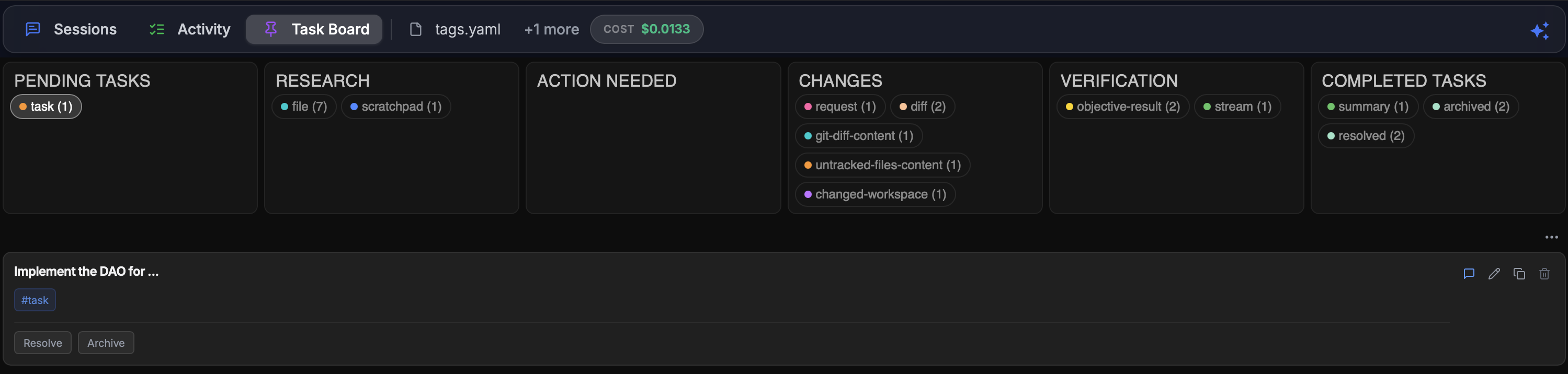
With chatbots the interaction model is linear and sequential. With Delegate, the interaction model is spatial and asynchronous: specialized agents work and post structured artifacts, and humans review, steer and approve.
The Task Board allows us to operate on the Ontologic Memory (OM) that is used by agents to push and pull information.
Visibility and steering: Because agents post their interim artifacts on the Task Board (e.g. research notes, files read, etc.), the reviewers can understand how decisions were made, make corrections, and add information to course correct the process.
When the agents need approval from human supervision, they post items in the OM and wait for a human supervisor to provide approval via the Task Board. Instead of working with LLMs as chatbots, we now have ample space via this fully customizable command center to verify and interact asynchronously.
Waterfall vs agile
Current agentic frameworks use a specification driven approach: a specification is created and then a product is built to that specification.
With Delegate the process is agile:
- One or more objectives are defined on the task board
- Agents can ask clarifying questions
- Objectives are broken down into smaller tasks
- Humans review the progress, pause and steer the processing
Flows
Business processes are modeled as user defined flows to match the specific needs of a use case.
Below is an example of a user defined flow for an automated coding agent.
A key capability of Delegate is the ability to define with ease such flows for domain specific needs.
Right now, the page explains how the components work (e.g., “Agents can ask clarifying questions,” “We model flows…”). It excels at showing the mechanics.
What it lacks is a compelling narrative that grounds these mechanics in real-world business pain.
Why this is critical: Technical audiences love deep dives, but they buy solutions to problems. A potential adopter (who might be a VP of Operations or an Engineering Director) reads this and thinks, “This is interesting technology,” but they aren’t convinced yet. They need to hear, “Our company struggled with X inefficiency, and Delegate solved it by implementing Y workflow.”
How to implement it (Actionable Plan):
- Create a dedicated section: Place this after the “Flows” section and before the conclusion.
- Structure the narrative using the STAR method:
- S (Situation/Problem): Start with a clear, expensive business problem. (e.g., “Our onboarding process for new compliance reports was manual, required 4-5 human touchpoints, and often stalled waiting for legal review.”)
- T (Task/Goal): Define the desired outcome. (e.g., “The goal was to automate the first 80% of the research and drafting, minimizing human intervention to only mandatory approvals.”)
- A (Action/Solution - Show the Delegate features here): Explain how Delegate facilitated the solution, referencing the core concepts already taught. (e.g., “We implemented a flow starting with Jira, utilizing OM to pull past reports, and pausing at the ‘Await Approval’ step for our legal team…”)
- R (Result/Impact): Quantify the success. (e.g., “This reduced the average time-to-completion from 7 days to 1 day, saving 40 engineering hours per month.”)
By adding this narrative layer, you shift the perceived value from “a complex piece of software” to “a proven revenue/efficiency multiplier.”